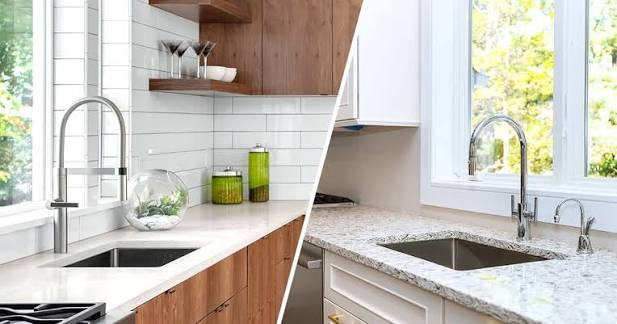

Choosing a kitchen worktop is an important decision because the surface needs to look good while handling everyday cooking, cleaning and general use. When comparing quartz vs granite countertops, both materials offer durability, attractive finishes and a wide range of styles. However, they differ in maintenance, appearance, heat resistance, stain resistance, installation and price.
Understanding these differences can make it easier to choose a worktop that suits your kitchen, lifestyle and budget. Neither material is automatically right for every home. The best option depends on how you use your kitchen and which features matter most to you.
What are quartz countertops?
Quartz worktops are engineered surfaces made primarily from natural quartz combined with resins and other materials. Manufacturers can control the production process to create consistent colours, patterns and finishes.
Unlike natural stone slabs, engineered quartz can be produced with a more predictable appearance. This is useful if you want a modern kitchen with a particular colour or pattern that needs to remain consistent across different areas.
Quartz is available in many styles, including designs that imitate marble, concrete and other natural stones. Some options have subtle patterns, while others have strong veining intended to create a dramatic focal point.
One of the main attractions of quartz is its relatively low-maintenance nature. Its non-porous surface generally does not require sealing, and everyday spills can usually be cleaned with a soft cloth and suitable household cleaner.
However, quartz is not completely maintenance-free. Strong heat, harsh chemicals and inappropriate cleaning products can damage the surface, so normal care is still important.
What are granite countertops?
Granite is a natural stone formed from geological processes deep within the earth. Each slab has its own combination of colours, mineral patterns and natural variations.
This means granite can provide a more individual appearance than manufactured surfaces. Even two slabs from the same type of granite may have differences in colour, pattern and mineral distribution.
Granite is known for being hard and durable. It can withstand normal kitchen use well when properly installed and maintained.
Many granite worktops are sealed to reduce the risk of staining and make the surface easier to maintain. The effectiveness and lifespan of the seal depend on the particular stone, the sealant used and how heavily the worktop is used.
Granite is available in many colours, from light and neutral options to darker stones with noticeable patterns. Because it is natural, however, the exact appearance can vary considerably between slabs.
Quartz vs granite countertops: the main differences
When looking at quartz vs granite countertops, there are several important differences to consider.
| Feature | Quartz | Granite |
|---|---|---|
| Material | Engineered stone | Natural stone |
| Appearance | More consistent and controlled | Naturally varied |
| Sealing | Generally not required | Usually requires periodic sealing |
| Stain resistance | Generally very good | Depends partly on sealing and stone type |
| Heat resistance | Good, but vulnerable to extreme heat | Generally excellent |
| Scratch resistance | High | High |
| Maintenance | Relatively low | Requires more maintenance |
| Pattern consistency | More predictable | Unique to each slab |
| Repairs | Damage can be difficult to disguise | Damage can also be difficult to repair invisibly |
| Price | Varies widely | Varies widely |
These are general characteristics rather than guarantees. The exact performance depends on the specific product, stone, installation quality and how the worktop is used.
Appearance and kitchen style
Appearance is often one of the biggest factors when choosing between quartz and granite.
Quartz is particularly useful if you want a controlled design. Because it is manufactured, you can often find multiple slabs with similar colours and patterns. This can help create a clean, coordinated appearance.
For example, a homeowner designing a contemporary white kitchen might choose a pale quartz worktop with subtle grey veining. The result can provide the appearance of natural stone while maintaining a relatively consistent pattern.
Granite offers something different. Its natural variation can give a kitchen more character. Flecks, mineral deposits, colour changes and patterns make each slab distinctive.
This can work particularly well in traditional, rustic or luxury-inspired kitchens where natural materials are part of the overall design.
The best choice therefore depends partly on whether you prefer consistency or natural variation.
Durability and everyday use
Both quartz and granite are durable options for kitchen worktops.
Quartz has a hard surface that generally handles everyday activities such as food preparation, chopping and cleaning well. However, it is not indestructible. Heavy impacts, particularly around edges or cut-outs, can cause damage.
Granite is also highly durable and can cope well with normal kitchen activities. Its natural stone composition makes it resistant to many forms of everyday wear.
Neither material should be treated as completely scratch-proof or damage-proof. Using chopping boards, avoiding unnecessary impacts and following the manufacturer's care instructions can help protect either surface.
The quality of the installation also matters. A well-supported worktop is less likely to experience problems than one that has been poorly fitted or inadequately supported.
Heat resistance
Heat is an important consideration for anyone who regularly cooks.
Granite generally performs very well around heat. Its natural stone composition means it can tolerate high temperatures better than many engineered surfaces.
Quartz can also cope with normal kitchen conditions, but extreme or sudden heat can damage the resin components within the material. Placing a very hot saucepan or baking tray directly on a quartz worktop is therefore not recommended.
Using heat-resistant mats or trivets is a sensible habit with quartz.
Even if granite is more tolerant of heat, using protection underneath extremely hot cookware is still a good practice. Repeated thermal stress can affect surfaces and finishes over time.
Stain resistance
Kitchen worktops regularly come into contact with coffee, tea, cooking oils, sauces, wine, fruit juice and other substances that can leave marks.
Quartz is generally highly resistant to staining because its surface is non-porous. Spills should still be cleaned promptly, particularly if they contain strongly coloured substances.
Granite has natural pores, although the degree of porosity varies between stones. A suitable sealant can help prevent liquids from penetrating the surface.
Granite that is not properly sealed or maintained may be more vulnerable to staining than quartz.
If your priority is easy everyday cleaning with minimal maintenance, quartz may appeal to you. If you prefer granite, regular care and appropriate sealing can help keep the worktop in good condition.
Maintenance requirements
One of the clearest practical differences between the two materials is maintenance.
Quartz usually needs relatively simple day-to-day care. Wiping spills with a soft cloth and appropriate cleaner is normally enough for routine cleaning.
Granite requires similar everyday cleaning but can also require periodic resealing. How often resealing is needed depends on the specific granite, the sealant and how the worktop is used.
You should always follow the care instructions supplied with the product rather than assuming every quartz or granite surface should be treated in exactly the same way.
Avoid abrasive cleaning products unless the manufacturer specifically states that they are suitable. Strong chemicals can also affect some surfaces.
Installation considerations
Both quartz and granite are heavy materials and normally require professional installation.
Before ordering a worktop, the installer needs accurate measurements and details of sinks, hobs, taps, joints and other cut-outs.
The kitchen units must also be capable of supporting the weight of the worktop.
Installation can involve cutting, polishing and joining the material. The number and position of joints can affect both the appearance and cost of the finished kitchen.
Access to the property should also be considered. Large stone slabs can be difficult to transport through narrow doorways, staircases or awkward spaces.
A professional installer can assess these issues before fabrication begins.
Cost of quartz vs granite countertops
There is no single price that applies to every quartz or granite worktop.
The total cost can vary according to:
- The material and grade selected
- Slab thickness
- Worktop size
- Number of slabs required
- Edge profile
- Sink and hob cut-outs
- Drainage grooves
- Joints
- Installation
- Delivery
- Removal of the existing worktop
- Location and local labour rates
Higher-end quartz designs can cost considerably more than basic options. Granite also ranges from relatively straightforward, affordable slabs to premium stones with distinctive colours and patterns.
When comparing quotations, look at the complete installed price rather than only the cost per square metre.
For example, one supplier may offer a lower material price but charge more for fabrication, delivery or cut-outs. Another may provide a higher material price but include more installation work in the quotation.
Getting several detailed quotations can make the comparison more useful.
Which material is easier to clean?
Quartz is generally easier to maintain because its non-porous surface does not normally need sealing.
For everyday cleaning, a soft cloth and suitable cleaner are usually sufficient. Spills should still be dealt with promptly rather than being left on the surface for long periods.
Granite can also be straightforward to clean once properly sealed. However, its maintenance requirements are higher because the seal may need to be renewed periodically.
If you want the simplest routine maintenance, quartz has an advantage. If you are comfortable with occasional maintenance and prefer natural stone, granite remains a practical choice.
Quartz for busy family kitchens
A busy household may benefit from a worktop that is straightforward to maintain.
Quartz can be particularly convenient because it generally offers good resistance to everyday staining and does not normally require sealing.
Imagine a kitchen where breakfast preparation happens every morning, children use the worktop for snacks and dinner preparation creates frequent spills. A low-maintenance surface can make daily cleaning simpler.
However, heat protection remains important. Hot cookware should not be placed directly on quartz simply because the surface is durable.
Granite for natural character
Granite may appeal to homeowners who want their worktop to have a natural, individual appearance.
A granite slab can become a prominent feature of the kitchen because of its natural patterns and mineral variations.
For example, a traditional kitchen with timber cupboards may work well with a granite surface containing natural flecks and contrasting tones.
Granite is also a useful option if high heat tolerance is an important consideration.
The trade-off is that you need to accept natural variation. If you want every section of the worktop to look almost identical, granite may not provide the level of consistency you are looking for.
Repairs and potential damage
Both materials can be damaged despite their durability.
Quartz can chip, particularly around exposed edges and cut-outs, or develop damage following a strong impact or excessive heat.
Granite can also chip or crack if subjected to significant impact, poor support or other stresses.
Small chips may sometimes be repaired by a specialist, although the repaired area may remain visible depending on its location, colour and pattern.
Preventing damage is usually preferable to relying on repairs. Use chopping boards, trivets and appropriate cleaning products, and avoid sitting or standing on the worktop.
Edges, sinks and other details
The worktop material is only one part of the finished design.
Edge profiles can change the appearance of a kitchen. A simple straight edge can suit a modern design, while a more detailed profile may work better in a traditional kitchen.
Sink installation is another consideration. Undermount sinks can create a clean appearance, while other sink styles may be chosen for practical or design reasons.
Hob cut-outs also need to be accurately planned.
These details can affect fabrication and installation costs, so they should be included when requesting quotations.
Environmental considerations
Quartz and granite have different production characteristics.
Granite is a natural material that is quarried and transported before being cut and finished. Quartz worktops involve manufacturing processes in which natural quartz is combined with other components.
Neither option should automatically be described as the more environmentally friendly choice in every situation. Quarrying, manufacturing, transport, packaging, installation and the expected lifespan of the product all affect the overall environmental impact.
If sustainability is important to you, ask suppliers about sourcing, manufacturing practices, recycled content where applicable and waste management.
Choosing a durable worktop that will remain in use for many years can also reduce the need for frequent replacement.
How to choose between quartz and granite
A simple way to narrow down the decision is to consider your priorities.
Quartz may suit you if you want:
- Low routine maintenance
- A non-porous surface
- Consistent colours and patterns
- A modern or highly controlled appearance
- Strong everyday stain resistance
Granite may suit you if you want:
- Natural stone
- Unique slab patterns
- Strong heat resistance
- A more organic appearance
- A distinctive worktop with natural variation
These are not strict rules. Both materials can work in many different types of kitchens.
Questions to ask before buying
Before committing to a worktop, ask the supplier or installer:
- What is included in the quoted price?
- Is installation included?
- How much will cut-outs cost?
- Are joints included?
- Does the material require sealing?
- What cleaning products are recommended?
- What warranty is provided?
- How long will fabrication take?
- Can I see the actual slab before ordering?
- How will the worktop be transported and installed?
Seeing the actual slab can be particularly useful with granite because natural variation can be significant.
For quartz, it can also help you understand how the pattern looks at full scale rather than judging it from a small sample.
Common mistakes to avoid
One mistake is choosing a worktop based entirely on appearance.
A beautiful surface may not be suitable for your cooking habits if you regularly expose it to conditions that the material is not designed to handle.
Another mistake is comparing only material prices. Installation, cut-outs, edges, delivery and other fabrication requirements can substantially affect the final cost.
It is also worth checking the care requirements before buying. A homeowner expecting a completely maintenance-free surface may be disappointed if they choose a material that requires regular sealing.
Finally, avoid assuming that a more expensive worktop will automatically be better for your kitchen. The right choice depends on the combination of appearance, performance, maintenance and budget.
Quartz vs granite countertops: which should you choose?
The decision between quartz and granite comes down to what you value most.
Quartz provides a manufactured surface with consistent design options, relatively simple maintenance and strong resistance to everyday staining. It can be a practical choice for households that want a polished appearance without regular sealing.
Granite provides natural stone with individual patterns, strong durability and excellent heat resistance. It can be particularly appealing when the natural character of the material is an important part of the kitchen design.
Your budget also matters. Because prices vary significantly for both materials, compare complete quotations rather than assuming one material will always cost more than the other.
The size and layout of your kitchen can also influence the final price, especially when multiple slabs, complicated cut-outs or numerous joints are required.
FAQ
Is quartz better than granite for kitchen worktops?
Neither is universally better. Quartz generally requires less maintenance and offers consistent patterns, while granite provides natural variation and stronger heat resistance. Your cooking habits, preferred appearance and maintenance expectations should guide the decision.
Does granite need to be sealed?
Many granite worktops benefit from sealing because natural stone can be porous. The exact requirement depends on the particular granite and the sealant used. Follow the supplier's maintenance recommendations.
Can you put hot pans on quartz?
It is best to avoid placing very hot pans or baking trays directly on quartz. Extreme heat can damage the resin components of engineered quartz. Use a suitable heat-resistant mat or trivet.
Is granite harder to maintain than quartz?
Generally, yes. Both materials need regular cleaning, but granite may also require periodic resealing. Quartz normally does not require sealing, making routine maintenance simpler.
Which is cheaper, quartz or granite?
Either material can be cheaper depending on the product selected. Prices vary by material grade, worktop size, fabrication, installation, location and project requirements. Comparing complete quotations is the most reliable way to assess the cost.
How long can quartz or granite worktops last?
Both can remain in good condition for many years when properly installed and cared for. Their lifespan depends on the quality of the material, installation, maintenance and how the worktop is used.
Conclusion
When comparing quartz vs granite countertops, the most important point is that both can provide a durable and attractive kitchen worktop. Quartz offers a consistent appearance, low routine maintenance and good resistance to everyday staining, while granite offers natural variation, excellent heat resistance and the distinctive character of natural stone.
Consider how you cook, how much maintenance you are willing to undertake, the style of your kitchen and your complete installed budget. Request detailed quotations and check exactly what is included before making a decision.
A well-chosen and properly installed worktop should complement your kitchen while providing a practical surface for everyday use for many years.