
Knowing how to create a home renovation budget can help you avoid unexpected financial pressure and make better decisions before work begins. Whether you are updating one room or renovating an entire property, having a clear spending plan gives you a better idea of what you can afford and which improvements should take priority.
A good renovation budget is more than a single figure. It should account for materials, labour, professional services, waste removal, unexpected repairs and a contingency fund. Costs can vary considerably depending on your location, property size, materials, labour rates and the complexity of the project.
How to create a home renovation budget from the start
The first step is to decide exactly what you want to change.
Walk through the property and make a room-by-room list. Separate essential repairs from improvements that would simply be nice to have.
For example, repairing damaged plaster or replacing unsafe electrical components may be essential, while installing bespoke shelving may be optional.
A simple list could look like this:
| Room | Essential work | Optional work |
|---|---|---|
| Kitchen | Replace damaged units | New premium worktops |
| Bathroom | Repair leaks | Heated flooring |
| Bedroom | Repair walls | Built-in wardrobes |
| Living room | Replace damaged flooring | Bespoke storage |
| Hallway | Repaint walls | New decorative lighting |
This approach prevents you from spending too much of your budget on cosmetic improvements while important repairs remain unfinished.
Establish how much you can realistically spend
Before getting excited about particular tiles, kitchens or flooring, establish your overall financial limit.
Consider money that is already available, savings you are comfortable using and any other funding you have genuinely planned for the project.
Do not assume that every pound you have available should be spent on the renovation.
It is sensible to retain money for normal household expenses and unexpected personal costs. Your renovation budget should fit within your wider financial situation rather than putting unnecessary pressure on it.
If you are considering borrowing money, make sure you understand the total repayment cost and whether the monthly payments are affordable.
Get an idea of likely renovation costs
Once you know what you want to do, research the likely cost of each part of the project.
For example, a renovation may involve:
- Painting and decorating
- Flooring
- Plastering
- Plumbing
- Electrical work
- Carpentry
- Kitchen installation
- Bathroom fitting
- Windows and doors
- Insulation
- Heating
- Structural work
- Waste removal
Avoid relying on one figure from a website or a single contractor.
Renovation prices vary according to location, labour availability, material quality, room dimensions, property condition and project requirements.
A large kitchen with premium cabinets will have a very different budget from a small kitchen receiving a cosmetic update.
Break the budget into categories
A useful renovation budget separates different types of spending.
For example:
| Category | Example |
|---|---|
| Materials | Flooring, tiles, paint, timber |
| Labour | Builder, plumber, electrician |
| Fixtures | Sinks, toilets, taps, lighting |
| Professional services | Designer, surveyor, engineer |
| Waste | Skip hire and disposal |
| Delivery | Materials and fixtures |
| Permissions | Applicable applications or fees |
| Contingency | Unexpected work |
This makes the budget easier to manage because you can see where the money is going.
It also makes it easier to identify areas where you could reduce spending if quotations come in higher than expected.
Separate labour from materials
When comparing quotations, find out whether labour and materials are included.
Some contractors provide a complete price, while others charge labour separately and ask the homeowner to purchase materials.
Neither arrangement is automatically better. What matters is understanding the total cost.
For example, a quote for installing flooring might appear inexpensive until you discover that preparation, underlay, trims, delivery and waste removal are excluded.
Ask for written details so you can compare quotations on a like-for-like basis.
Set priorities before choosing finishes
One of the easiest ways to lose control of a renovation budget is to make decisions based on individual products rather than the overall project.
Instead, decide what matters most.
Your priorities might include:
- Safety and essential repairs
- Structural problems
- Plumbing and electrical issues
- Heating, insulation and energy improvements
- Functional improvements
- Flooring and decoration
- Optional design features
This does not mean decorative improvements are unimportant. It simply ensures that essential work is funded before optional upgrades.
Allow for unexpected costs
Even well-planned renovations can uncover problems.
A wall may contain damaged wiring. Removing old flooring could reveal an uneven subfloor. Opening up a bathroom might expose damaged pipework.
Older properties can be particularly difficult to estimate because some problems may not be visible until work begins.
For this reason, include a contingency fund in your budget.
A planning allowance of around 10% to 20% is commonly used, although the appropriate amount depends on the property's age, condition and the complexity of the work.
For example, if your planned renovation costs £20,000, a 10% contingency would be £2,000, while a 20% contingency would be £4,000.
The contingency should be treated as money reserved for genuine surprises rather than extra spending money.
Create a room-by-room cost plan
If you are renovating several areas, divide the total budget between rooms.
For example:
| Room | Planned budget |
|---|---|
| Kitchen | £12,000 |
| Bathroom | £7,000 |
| Living room | £3,500 |
| Two bedrooms | £4,000 |
| Hallway | £1,500 |
| Contingency | £5,600 |
| Total | £33,600 |
These figures are only an example. Actual renovation costs can be much higher or lower depending on property size, location, materials, labour and project requirements.
A room-by-room plan helps prevent one part of the project from consuming money intended for another.
Decide where to spend more
Not every element needs the same level of investment.
It can make sense to spend more on items that are used frequently or are difficult to replace.
For example, you may want to prioritise:
- Durable kitchen worktops
- Good-quality flooring
- Reliable bathroom fittings
- Effective insulation
- Suitable windows
- Quality electrical components
- Proper waterproofing
You could then choose simpler decorative finishes where premium products would have little practical benefit.
The right balance depends on your priorities, property and how long you expect to live there.
Identify where you can save money
Budgeting does not necessarily mean buying the cheapest available products.
A better approach is to identify work that can be simplified without affecting the quality of the finished result.
For example, keeping the existing kitchen or bathroom layout can reduce the need to move plumbing and electrical connections.
Other potential savings include:
- Keeping suitable existing doors
- Refurbishing cabinets instead of replacing them
- Choosing standard-sized fittings
- Comparing material suppliers
- Buying materials during sales
- Reusing suitable fixtures
- Doing straightforward decorating yourself
- Renovating rooms in stages
Always consider durability when choosing cheaper materials. Replacing an inexpensive product several times can ultimately cost more than buying a suitable durable option initially.
Get several quotations
For significant renovation work, obtaining multiple quotations can give you a better understanding of the potential cost.
Try to provide each contractor with the same information so the quotations can be compared fairly.
Ask each contractor to explain:
- What work is included
- Which materials are included
- Labour costs
- Expected timescale
- Waste removal arrangements
- Payment schedule
- What happens if unexpected work is discovered
- Whether VAT applies
- Which parts of the project require specialist trades
Do not simply choose the cheapest quotation.
A significantly lower price may indicate that important work has been excluded, although a high price does not automatically guarantee better workmanship.
How to create a home renovation budget for different property sizes
Property size has a major influence on renovation costs.
A small flat may require less flooring, paint and labour than a large detached house. However, some fixed costs remain similar regardless of property size.
For example, installing a bathroom still requires plumbing, sanitaryware, electrical work and labour even if the room is relatively small.
Large homes can also have more complicated layouts, additional rooms and greater heating or electrical requirements.
When estimating costs, consider the actual amount of work rather than relying entirely on a price per square metre.
Include professional and specialist costs
Some projects require more than builders and decorators.
Depending on the work, you may need:
- An architect or architectural technician
- Structural engineer
- Building surveyor
- Quantity surveyor
- Specialist heating professional
- Electrician
- Gas engineer
- Other qualified trades
Not every renovation needs these professionals, but significant structural or technical work may require specialist advice.
Include these potential costs early rather than treating them as an afterthought.
Remember waste removal and delivery
Waste disposal is easy to overlook when preparing a renovation budget.
Removing old cabinets, flooring, tiles, plasterboard, bathroom fittings and other materials can generate a substantial amount of waste.
Depending on the project, you may need skip hire, waste collection or other disposal arrangements.
Delivery charges can also add to the cost, particularly when purchasing large or heavy materials.
Ask contractors and suppliers whether these costs are already included.
Plan the payment schedule
A renovation budget should consider not only how much the project costs but also when money will be needed.
Large projects may involve several stages of payment.
For example, you may need money for materials before installation begins, followed by payments as different stages of the project are completed.
Make sure you understand the payment schedule before work starts.
Keep records of payments, quotations, invoices and changes to the original agreement.
Avoid making significant changes without understanding their effect on the final budget.
Track spending throughout the renovation
Creating a budget is only the beginning.
You also need to monitor spending while the work is underway.
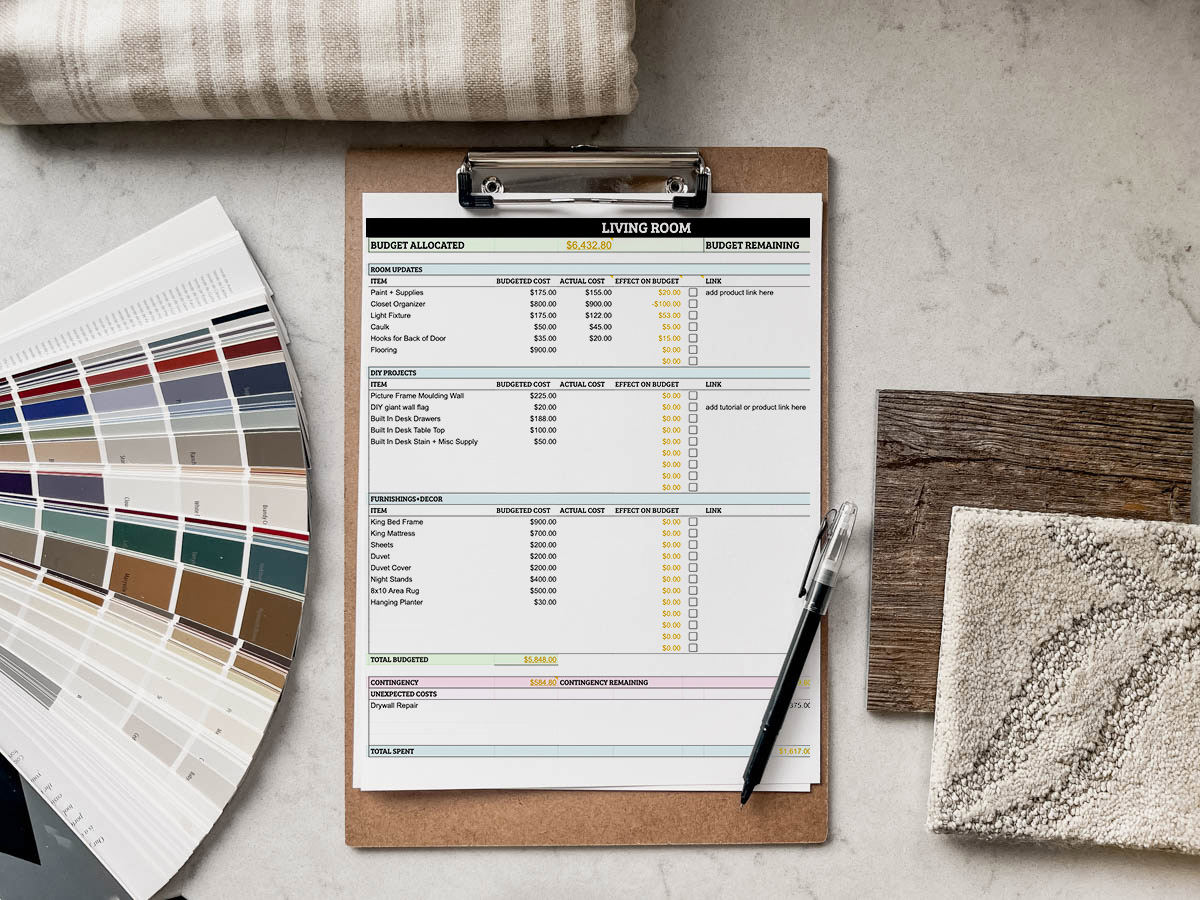
A simple spreadsheet can include:
| Item | Budget | Actual cost | Difference |
|---|---|---|---|
| Flooring | £2,000 | £1,850 | £150 under |
| Painting | £1,200 | £1,300 | £100 over |
| Lighting | £800 | £750 | £50 under |
| Plumbing | £2,500 | £2,700 | £200 over |
Update your figures whenever you make a purchase or receive a revised quotation.
This gives you an early warning if spending starts to move beyond your original plan.
Deal with changes carefully
Changes during renovation are common, but they can quickly increase costs.
For example, you may decide that you want more expensive tiles after work has already started. You may also discover that a planned fitting is unavailable and needs to be replaced with another product.
Before approving a change, ask:
- How much will it cost?
- Will it affect labour?
- Will it delay the project?
- Does it require additional materials?
- Is the change essential?
Small changes can add up, so record them as part of the overall budget.
Avoid designing around trends alone
A renovation should suit the property and the people who live in it.
Trends can be useful for inspiration, but expensive features may not remain appealing to you for many years.
Focus on practical improvements such as good storage, durable flooring, useful lighting, comfortable heating and sensible layouts.
You can add personality through paint, furniture and accessories that are easier to change later.
Consider renovation in stages
You do not always have to complete everything at once.
If the budget is limited, divide the project into sensible stages.
For example:
Stage one: structural repairs and essential maintenance
Stage two: kitchen and bathroom improvements
Stage three: flooring and decoration
Stage four: optional storage and design features
Staging the work can make the financial commitment easier to manage.
However, avoid completing decorative work immediately before major construction. There is little benefit in painting a wall if it will soon be opened up for electrical or plumbing work.
Review the budget before work begins
Before signing contracts or ordering large quantities of materials, review your entire budget.
Check that you have allowed for:
- Labour
- Materials
- Fixtures
- Professional services
- Waste
- Delivery
- Permissions where required
- Contingency
- Temporary accommodation if necessary
- Storage or moving costs if applicable
Then compare the total with the amount you can realistically afford.
If the project is over budget, reduce or postpone optional work before construction starts.
This is usually easier than trying to cut costs after contractors are already on site.
FAQ about creating a home renovation budget
How much should I budget for a home renovation?
There is no universal figure. The cost depends on the size and condition of the property, location, labour, materials and the type of work required. A cosmetic update can cost far less than a renovation involving structural, plumbing or electrical changes.
What percentage should I keep for unexpected renovation costs?
A contingency of around 10% to 20% can be useful for many projects. Older properties or complex renovations may require a larger reserve because unexpected problems can be more difficult to predict.
Should labour or materials come first in my budget?
Both should be included from the beginning. Separating labour and materials can make quotations easier to compare and help you identify where costs are increasing.
Can I renovate my home on a limited budget?
Yes. Prioritise essential repairs, keep existing layouts where practical, compare quotations and postpone optional upgrades. Renovating in stages can also spread the cost over time.
Should I get more than one renovation quotation?
For significant work, comparing several detailed quotations can be useful. Make sure you compare what each contractor has included rather than looking only at the final price.
How can I stop a renovation budget from getting out of control?
Start with a detailed scope of work, set priorities, include a contingency fund, track every expense and record changes. Avoid making unnecessary design changes once the project has started.
Conclusion
Learning how to create a home renovation budget is one of the most useful steps you can take before starting a major improvement project. A clear budget helps you understand what you can afford, prioritise essential work and identify areas where you can make sensible savings.
Start by listing the work required in each room, research realistic costs and separate labour, materials and other expenses. Get detailed quotations where appropriate and remember that prices vary according to location, materials, labour, property size and project requirements.
Most importantly, leave room for unexpected costs. A renovation rarely goes exactly according to the original plan, particularly in older properties.
A well-prepared budget does not need to predict every pound perfectly. Its purpose is to give you a realistic framework for making decisions, controlling spending and completing the improvements your home actually needs.