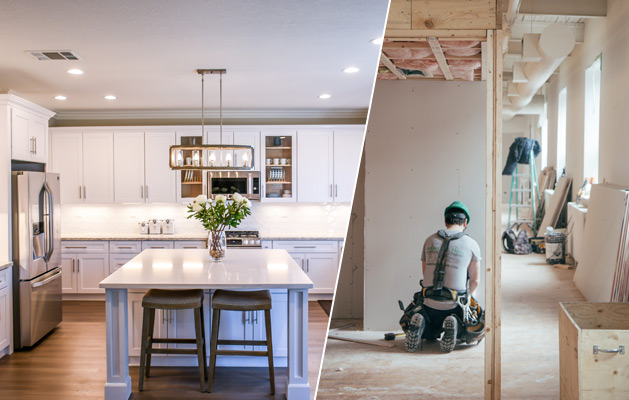

Renovation vs remodeling: what is the difference? The two terms are often used interchangeably when discussing home improvement, but they can describe different types of work. In simple terms, renovation usually involves repairing, updating or improving an existing space without fundamentally changing its purpose or structure. Remodeling generally involves changing the design, layout or function of a room or property.
Understanding the difference can help you describe your project more accurately, compare contractor quotations and create a realistic budget. Whether you are updating a tired kitchen, improving a bathroom or changing the layout of an entire house, knowing what type of work you need is a useful starting point.
Renovation vs remodeling: what is the difference?
The main difference is the extent and purpose of the work.
A renovation typically improves an existing room while keeping its basic layout and function. For example, painting walls, replacing flooring, updating kitchen cupboard doors or installing new bathroom fittings could all be considered renovation work.
Remodeling usually goes further. It can involve changing the layout, removing or adding walls, relocating plumbing, altering electrical systems or changing how a room is used.
For example, replacing worn kitchen cabinets while keeping the sink, cooker and appliances in the same positions is generally a renovation. Turning a separate kitchen and dining room into one open-plan space is more likely to be described as a remodel.
The terminology is not always used consistently, particularly by builders, estate agents and homeowners. Some professionals use the words interchangeably, so the actual scope of work is more important than the label.
What is a home renovation?
A renovation is generally about restoring, repairing, refreshing or improving an existing space.
The basic structure and purpose of the room usually remain unchanged.
Common renovation work includes:
- Painting and decorating
- Replacing flooring
- Repairing plaster
- Replacing doors
- Updating light fittings
- Replacing kitchen worktops
- Installing new kitchen cupboard doors
- Replacing bathroom fittings
- Repairing or replacing damaged fixtures
- Improving insulation
- Updating finishes and surfaces
For example, if your bedroom has old carpet, damaged paintwork and outdated light fittings, replacing these items would normally be considered renovation rather than a major remodel.
Renovation can range from a relatively small cosmetic project to a substantial refurbishment involving several rooms.
What is home remodeling?
Remodeling normally involves changing the design, layout or function of a property.
The work can be more invasive because it may require changes to the physical arrangement of the building.
Examples include:
- Removing an internal wall
- Creating a new doorway
- Combining two rooms
- Moving a kitchen to another part of the house
- Converting a garage into living space
- Changing a bathroom layout
- Creating an open-plan kitchen and dining area
- Converting an attic into a bedroom
- Adding new rooms
- Reconfiguring internal spaces
A remodel does not necessarily mean completely rebuilding a property. A relatively small change, such as moving a kitchen sink and rearranging the cabinets to create a different layout, could still involve remodeling.
The important point is that the project changes more than the appearance of the existing space.
Key differences between renovation and remodeling
Although the terms overlap, the following comparison can help.
| Renovation | Remodeling |
|---|---|
| Usually updates an existing space | Usually changes the design or layout |
| Often focuses on repairs and finishes | Often involves structural or functional changes |
| May be less disruptive | Can involve significant disruption |
| Usually keeps the existing purpose | Can change how a space is used |
| Often requires fewer trades | May require several specialist trades |
| Can be completed relatively quickly | May take considerably longer |
| Usually has fewer design changes | Often requires detailed planning |
These are general distinctions rather than strict rules. A renovation can become complicated, while a small remodel may be relatively straightforward.
Renovation examples
Imagine a 15-year-old kitchen that still has a practical layout but looks dated.
You could renovate it by:
- Repainting the walls
- Replacing cupboard doors
- Installing new handles
- Replacing the worktop
- Changing the flooring
- Upgrading the lighting
- Replacing older appliances
The position of the sink, cooker and cabinets could remain largely unchanged.
This approach can improve the appearance and usability of the kitchen without completely changing its design.
Another example is a bathroom where the existing layout works well but the fittings are old. Replacing the toilet, basin, shower, tiles and flooring could be considered renovation.
Remodeling examples
Now imagine that the same kitchen is too small and separated from the dining room.
You decide to remove a wall, create one larger space, move the sink, reposition appliances and install a new kitchen layout.
That would generally be considered remodeling because the structure and arrangement of the space have changed.
Similarly, converting a spare bedroom into a bathroom would involve a significant change in function. It could require new plumbing, drainage, ventilation, electrical work and structural considerations.
Which is usually more expensive?
There is no fixed rule, but remodeling often costs more than a straightforward renovation because it can involve additional labour, design work, structural changes and specialist trades.
A basic renovation might involve decorating, flooring and replacement fittings.
A remodel could require:
- Architectural or design services
- Structural calculations
- Building work
- Plumbing changes
- Electrical alterations
- New drainage
- Additional ventilation
- New doors or windows
- Waste removal
- Building control involvement where applicable
However, a high-quality renovation can also become expensive. Replacing an entire kitchen with premium materials, for example, could cost more than a modest room remodel.
All cost estimates depend on location, labour rates, materials, property size, access, specification and the exact requirements of the project.
Renovation costs to consider
The cost of renovating a room can vary significantly.
A basic renovation involving painting and flooring might cost hundreds or a few thousand pounds, depending on the room and materials.
A more extensive renovation involving new fittings, plastering, electrical work and higher-quality finishes can cost considerably more.
For example, a bedroom refresh may be relatively inexpensive if the walls, electrics and flooring are in good condition. A kitchen renovation can require a much larger budget because cabinets, appliances, worktops, plumbing and electrical systems may all need attention.
Before setting a budget, list every element you intend to replace rather than relying on a single overall estimate.
Remodeling costs to consider
Remodeling budgets can be harder to predict because structural and layout changes can reveal additional requirements.
Removing a wall, for example, may require an assessment to determine whether it is load-bearing. If it is structural, additional engineering, temporary support and specialist building work may be required.
Moving a kitchen or bathroom can also increase costs because water supplies, waste pipes, electrical connections and ventilation may need to be relocated.
The cost of a remodel therefore depends heavily on what is being changed.
A simple layout alteration may be manageable, while a whole-house reconfiguration can become a major construction project.
Do renovations require planning permission?
Not every renovation requires planning permission.
Painting, replacing flooring, changing kitchen units and many similar internal improvements can usually be completed without planning permission.
However, certain alterations can require permission or approval depending on the property, location and nature of the work.
Structural changes, extensions, conversions and alterations to listed buildings or properties in certain designated areas may have additional requirements.
Building regulations can also apply even where planning permission is not required. Electrical, structural, fire safety, insulation, ventilation and other work may need to meet relevant standards.
Before starting significant work, check the requirements that apply to your particular property and project.
Do remodels always require an architect?
No. An architect is not automatically required for every remodeling project.
A small internal alteration may be manageable with a builder and appropriate specialist input.
However, an architect or architectural technician can be useful for larger or more complicated projects, particularly where the layout is changing significantly or an extension is involved.
A structural engineer may also be needed where walls, floors, roofs or other structural elements are being altered.
The right professionals depend on the scope and complexity of the project.
How to decide between renovation and remodeling
Start by asking what you actually want to achieve.
If the room already works well but looks tired, renovation may be enough.
If the room is too small, poorly arranged or unsuitable for how you use it, remodeling may make more sense.
Consider these questions:
- Does the existing layout work?
- Do you need more space?
- Is the room being used for the right purpose?
- Are the main problems cosmetic or functional?
- Will moving walls solve the problem?
- Will plumbing or electrics need to be relocated?
- How much disruption can you manage?
- What is your available budget?
- How long do you plan to stay in the property?
Answering these questions can help prevent unnecessary building work.
When renovation may be the better option
Renovation can make sense when the basic structure and layout of your home are suitable.
For example, if a kitchen has enough space and a sensible arrangement, replacing the cabinets, worktop, flooring and lighting may provide the improvement you need.
Renovation can also be appropriate when your budget is limited or when you want to improve the property gradually.
Another advantage is that the project may be less disruptive than major structural work.
When remodeling may make more sense
Remodeling can be worth considering when the existing layout creates a genuine problem.
For example, a small kitchen separated from a dining room may not provide enough usable space for a growing household.
A remodel could potentially improve how the available space is organised.
The same applies to properties with unused rooms, awkward corridors or spaces that no longer match the needs of the household.
However, layout changes should be carefully planned. Removing a wall simply because an open-plan layout is popular may not necessarily improve every property.
Can you combine renovation and remodeling?
Yes. Many home improvement projects involve both.
For example, you might remodel a kitchen by changing its layout and then renovate the resulting space with new flooring, cabinets, lighting, worktops and decoration.
A loft conversion is another example. The conversion changes the function and structure of the space, while decorating, flooring and fitting storage are renovation elements.
Thinking about the project in terms of individual tasks rather than labels can make planning much easier.
Common mistakes to avoid
One common mistake is underestimating preparation work.
Homeowners may budget for new flooring without considering the condition of the existing floor. Similarly, they may budget for new kitchen units without allowing for plumbing, electrical changes, removal and installation.
Another mistake is changing the design after work has started.
Late changes can increase labour costs, delay the project and result in materials being wasted.
It is also important not to choose a contractor based solely on the lowest quotation. Make sure you understand exactly what is included and whether additional costs could arise.
How to plan your project
A good project starts with a clear description of what you want to achieve.
Create a room-by-room list of work and separate essential improvements from optional upgrades.
For example:
| Priority | Example |
|---|---|
| Essential | Repairing damaged walls |
| Essential | Fixing unsafe electrical issues |
| Useful | Improving lighting |
| Useful | Replacing worn flooring |
| Optional | Bespoke storage |
| Optional | Premium decorative finishes |
Once you have your list, obtain detailed quotations where appropriate.
It is also sensible to keep a contingency fund for unexpected work. Around 10% to 20% is commonly used as a planning allowance, although older properties and complex projects may require more.
FAQ about renovation vs remodeling
Is renovation the same as remodeling?
Not exactly. Renovation generally focuses on repairing, updating or improving an existing space, while remodeling usually changes the layout, design or function. However, the terms are often used interchangeably in everyday conversation.
Which is cheaper, renovation or remodeling?
A straightforward renovation is often less expensive than a major remodel, but there is no universal rule. The final cost depends on materials, labour, property size, location and the amount of work involved.
Can a renovation involve structural work?
It can. The distinction is not absolute, and some projects described as renovations may include structural repairs or alterations. The actual scope of work is more important than the terminology.
Do I need planning permission for a remodel?
Not necessarily. Requirements depend on the type of work, property and location. Some structural alterations, extensions and conversions may require permission or other approvals, while many internal changes do not.
Can I renovate before selling my house?
Yes. Updating worn decoration, flooring, lighting or other visible features can improve the presentation of a property. However, it is important to consider the likely benefit before spending heavily on improvements.
Should I renovate or remodel my home?
The answer depends on the problem you are trying to solve. If the layout works but the property looks dated or worn, renovation may be suitable. If the layout or function is the main problem, remodeling may be more appropriate.
Conclusion
Understanding renovation vs remodeling: what is the difference? can make it easier to plan a home improvement project and communicate your requirements to contractors.
Renovation generally focuses on improving what already exists, while remodeling is more concerned with changing the layout, design or function of a space. Neither approach is automatically right for every property.
Start by identifying the problem you want to solve. If the existing layout works, a renovation may provide the improvements you need without unnecessary disruption. If the space no longer suits your needs, a carefully planned remodel may provide a more fundamental solution.
Whatever approach you choose, create a realistic budget, obtain detailed quotations and allow for unexpected costs. Most importantly, plan the work around the way you actually use your home rather than simply following trends.