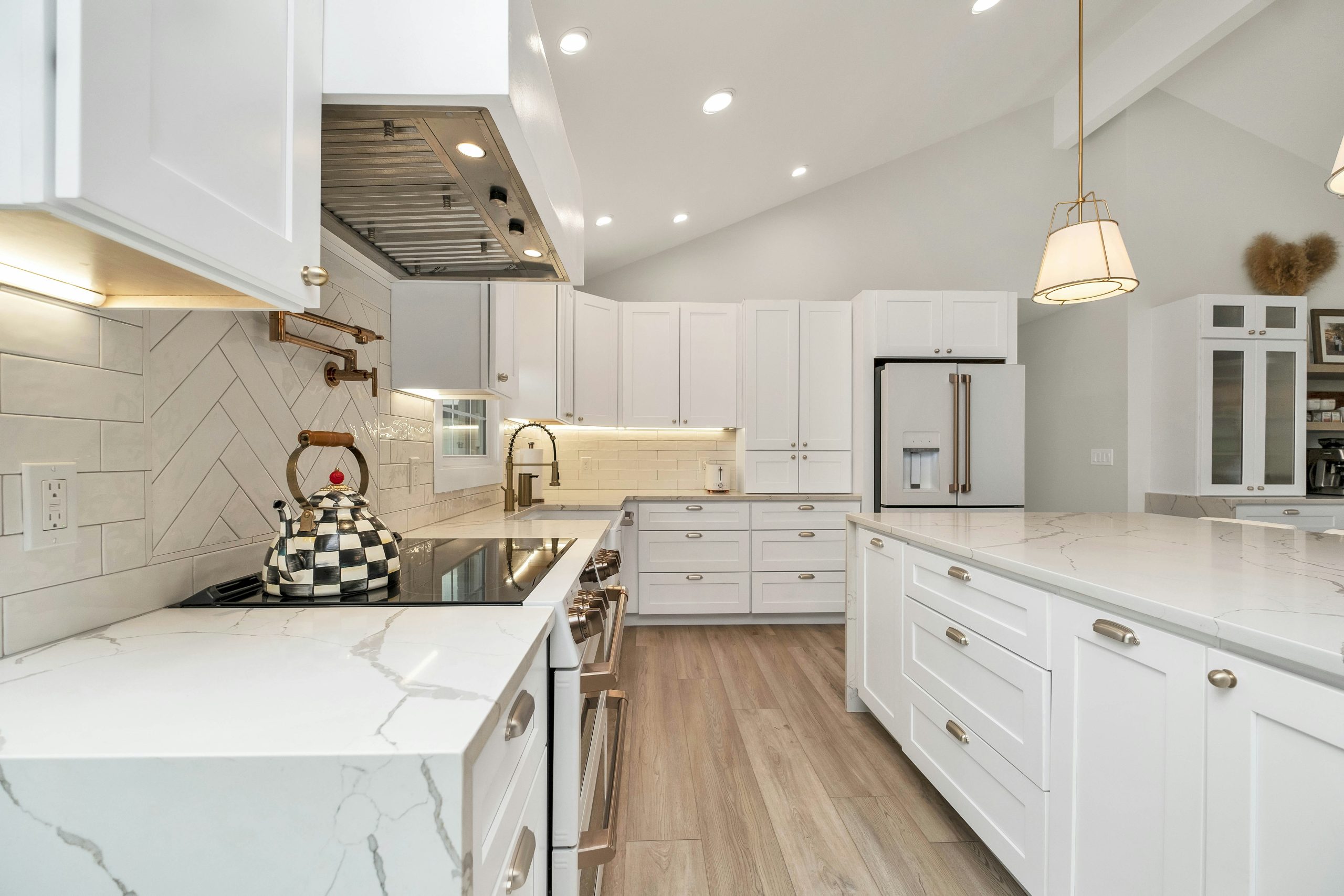

If you are planning a kitchen renovation, one of the first questions you may ask is, how much do new kitchen cabinets cost? Cabinets can account for a substantial part of a kitchen renovation budget, but there is no single price that applies to every home. The final amount depends on the size of the kitchen, cabinet style, materials, quality, labour, installation and location.
New cabinets can range from relatively simple off-the-shelf units to fully customised cabinetry. Understanding the different options and the costs involved can help you plan realistically and avoid unexpected expenses.
How much do new kitchen cabinets cost?
The cost of new kitchen cabinets varies widely depending on what you buy and how much installation work is required.
For a small kitchen using basic, standard-sized units, the cabinet supply cost may be relatively modest. A larger kitchen with more cupboards, drawers, specialist storage and custom-made units will naturally cost more.
A useful way to think about the cost is by separating the project into three areas:
- Cabinet supply
- Installation and fitting
- Additional work and materials
The cabinet price itself may not include handles, hinges, worktops, delivery, removal of old units or alterations to plumbing and electrical systems.
Prices also vary by location, labour rates, materials, property size and project requirements, so local quotations are important before setting a final budget.
What affects the price of kitchen cabinets?
Several factors influence the final price.
The most obvious is the number of cabinets required. A larger kitchen usually needs more units, although the layout and amount of storage also matter.
The material and construction method can have a significant effect. Basic manufactured-board cabinets may cost less than higher-specification options or bespoke timber cabinetry.
Other factors include:
- Cabinet size
- Number of drawers
- Door style
- Internal storage features
- Cabinet finish
- Handles and hardware
- Corner units
- Tall units
- Appliance housing
- Custom measurements
- Installation requirements
A simple kitchen with standard units can therefore have a very different price from a highly customised kitchen, even if both rooms are a similar size.
Standard kitchen cabinets
Standard or modular cabinets are manufactured in commonly used sizes.
They are generally designed to fit together in a range of kitchen layouts, making them a popular choice for homeowners who want to control costs.
The main advantages include:
- A wide range of sizes
- Faster availability
- Easier replacement
- Many style options
- Straightforward planning
- Potentially lower manufacturing costs
However, standard units may not make perfect use of every centimetre of an unusual kitchen.
Small gaps may need to be filled with panels or other components, and awkward corners can sometimes be less efficient.
Bespoke kitchen cabinets
Bespoke cabinets are made to suit the specific dimensions and requirements of a kitchen.
They can be useful where the room has unusual walls, limited space, sloping ceilings or specific storage requirements.
You can usually have greater control over:
- Dimensions
- Materials
- Door designs
- Internal storage
- Finishes
- Hardware
- Cabinet arrangement
The trade-off is that bespoke cabinetry generally involves more design, manufacturing and installation work.
The cost can therefore be considerably higher than standard units.
Flat-pack kitchen cabinets
Flat-pack cabinets are supplied in components that are assembled before or during installation.
They can provide a way to reduce the purchase price, particularly when compared with some fully assembled or bespoke options.
However, the total project cost still depends on assembly, delivery, installation and the quality of the chosen products.
If you plan to assemble them yourself, make sure you are comfortable with accurate measuring, levelling and fitting.
A mistake during assembly can affect how doors and drawers operate.
Fully assembled cabinets
Fully assembled units arrive ready to install.
This can make the installation process simpler, although the cabinets themselves may cost more than flat-pack alternatives.
For homeowners who want to reduce the amount of assembly work involved, this may be worth considering.
Compare the complete costs rather than assuming one option is automatically cheaper.
Cabinet materials and construction
The material used to construct the cabinet can influence its price, appearance and durability.
Common options include manufactured wood-based boards, plywood and solid timber components.
Different manufacturers use different construction methods and material combinations, so the term used to describe a cabinet does not always tell you everything about its quality.
When comparing products, look at the complete specification rather than focusing only on the door appearance.
Consider the cabinet box, shelves, hinges, drawer mechanisms and protective finishes as well.
Cabinet doors can change the price
The doors are one of the most visible parts of a kitchen.
Simple slab-style doors can have a different price from more detailed framed or shaker-style designs.
Finishes also vary. For example, painted, wood-effect, laminate and other decorative finishes may be available at different price points.
If you are working with a limited budget, compare several door styles while keeping the cabinet layout similar.
A change in door design can alter the overall appearance without necessarily requiring a completely different kitchen plan.
Drawers can cost more than cupboards
Drawers are convenient for storing pans, utensils and other frequently used items, but drawer units can cost more than simple cupboard units.
This does not mean you should avoid drawers.
Instead, use them strategically.
For example, deep drawers near a food preparation area can provide useful storage for pans and larger items, while standard cupboards may be sufficient for less frequently used equipment.
This allows you to balance convenience with your overall budget.
Tall cabinets and pantry units
Tall units can provide substantial storage, but they can also add to the cabinet budget.
A tall pantry, larder or appliance housing unit requires more material than a standard wall or base cabinet.
Before adding several tall units, consider whether you genuinely need the storage.
In smaller kitchens, a carefully organised standard cabinet can sometimes provide enough capacity without adding expensive cabinetry.
Corner cabinets
Corners can be one of the more complicated areas of a kitchen.
Specialist corner units and storage mechanisms can make awkward spaces easier to use, but they can also increase the cost.
Depending on your layout, a simple corner cupboard may be sufficient.
If you want pull-out mechanisms or rotating storage systems, include their cost when comparing the overall cabinet options.
Do not forget installation costs
When asking how much do new kitchen cabinets cost, it is important to distinguish between the price of the cabinets and the cost of having them installed.
Installation can involve:
- Removing existing cabinets
- Preparing the room
- Levelling units
- Fixing cabinets securely
- Fitting doors and drawers
- Installing handles
- Fitting panels and trims
- Adjusting appliance housings
- Installing worktops
- Making plumbing or electrical adjustments
Labour rates vary considerably by location and contractor.
Ask for an itemised quotation so you can see exactly what is included.
Removing the old kitchen
If you are replacing an existing kitchen, the old cabinets have to be removed.
Some installers include removal in their quotation, while others charge separately.
There may also be costs for transporting and disposing of old cabinets, worktops, appliances and other materials.
If you are comparing quotations, check whether these services are included.
A quotation that initially appears cheaper may have additional removal and disposal charges.
Worktops are usually a separate cost
Kitchen cabinets and worktops are closely connected, but they are normally priced separately.
Worktop costs depend on the material, size, thickness, number of joins and cut-outs required.
Laminate, timber, engineered surfaces and natural stone can all have different price ranges.
The final price can also increase when specialist cutting or installation is needed.
If you are budgeting for new cabinets, remember to allocate money for the worktop unless you intend to reuse your existing one.
Handles and hardware
Cabinet hardware is another cost that can be easy to overlook.
A kitchen may require dozens of handles, along with hinges, drawer runners and other fittings.
Prices vary significantly depending on the design and quality.
You do not necessarily need the most expensive hardware, but poor-quality components can affect everyday use.
When comparing cabinet packages, check what hardware is already included.
Appliance housing
Integrated appliances require cabinets designed to accommodate them.
This can include housing for:
- Ovens
- Dishwashers
- Refrigerators
- Washing machines
- Microwaves
The cabinet dimensions need to match the appliance specifications.
Do not order cabinets based only on the appliance's visible dimensions. Installation requirements and ventilation can also matter.
Plumbing and electrical changes
Replacing cabinets does not automatically require major changes to plumbing or electrical systems.
However, if the new design moves sinks, appliances, sockets or other services, additional work may be necessary.
This can increase the project cost.
If you are trying to keep the renovation affordable, maintaining the existing locations of major services can reduce the amount of additional work required.
Where specialist electrical, gas or plumbing work is required, use an appropriately qualified professional.
Can you save money by keeping some cabinets?
Yes, depending on their condition and your planned layout.
You do not necessarily have to replace every cabinet.
For example, you might replace damaged base units while retaining suitable wall cabinets. Alternatively, you could keep the cabinet boxes and replace the doors and drawer fronts.
This approach can reduce the amount of material and labour required.
However, make sure the retained units are compatible with the new design and in good enough condition to justify keeping them.
Cabinet replacement versus refinishing
If your existing cabinets are structurally sound, refinishing may be an alternative to full replacement.
Painting suitable doors, changing handles and replacing selected components can alter the appearance without removing the cabinet boxes.
Replacement becomes more relevant when the existing units have serious damage, poor storage, unsuitable dimensions or a layout that no longer works.
The best option depends on the condition of the kitchen and what you want to achieve.
Example kitchen cabinet budget
Imagine a medium-sized kitchen that needs new base cabinets, wall units and a few drawers.
The homeowner might divide the budget into:
| Budget area | What it covers |
|---|---|
| Cabinet units | Base, wall and tall units |
| Doors and fronts | Style and finish |
| Hardware | Handles, hinges and drawer runners |
| Installation | Assembly and fitting |
| Removal | Taking out old units |
| Worktop | New working surface |
| Delivery | Transport of materials |
| Additional work | Plumbing, electrical or preparation |
The exact figures will vary considerably according to location, cabinet specification, labour and the size and complexity of the kitchen.
This approach is useful because it prevents the cabinet price from being treated as the entire renovation budget.
How to compare kitchen cabinet quotations
When you receive quotations, make sure you are comparing like for like.
One supplier may quote only for cabinets, while another may include installation, panels and hardware.
Ask each supplier to explain:
- Number and size of units
- Cabinet construction
- Door material and finish
- Hardware included
- Delivery
- Installation
- Worktops
- Removal of existing cabinets
- Waste disposal
- Any additional charges
A detailed quotation makes it easier to identify genuine differences in price.
When is the cheapest cabinet option suitable?
Lower-cost cabinets can be suitable when the kitchen has a simple layout and the homeowner wants a straightforward renovation.
They may also make sense for properties where a complete bespoke kitchen is not necessary.
However, price should not be the only consideration.
Think about how frequently the kitchen will be used, how much storage is needed and how important long-term durability is to you.
When is it worth spending more?
Spending more may be worth considering for features that you use every day.
Examples could include:
- Frequently used drawers
- Heavy-duty hinges
- High-use cabinet doors
- Custom storage
- Difficult corners
- Specialist appliance housing
The decision should depend on your needs rather than simply choosing the most expensive specification.
Plan before ordering
Accurate measurements are essential.
Measure wall lengths, ceiling height, doorways, windows and existing service positions.
Also consider:
- Appliance dimensions
- Door opening space
- Worktop depth
- Walkway clearance
- Socket positions
- Plumbing
- Radiators
- Extractor requirements
A professional kitchen designer or installer can help identify potential problems before cabinets are ordered.
Allow for unexpected costs
Even with careful planning, renovation projects can uncover issues that were not visible initially.
Old flooring may be damaged beneath cabinets. Walls may need repair, or plumbing and electrical systems may require attention.
A contingency fund can help cover these unexpected requirements.
The appropriate amount depends on the age of the property and complexity of the renovation. It should be treated as a planning reserve rather than a guaranteed cost.
Frequently asked questions
How much do new kitchen cabinets cost on average?
There is no single average price that accurately applies to every kitchen. Cabinet costs vary according to kitchen size, number of units, materials, door style, storage features, location and labour. Installation and additional work can also substantially affect the final amount.
Are kitchen cabinets expensive to replace?
They can represent a significant part of a kitchen renovation budget, particularly when you choose bespoke units or make major layout changes. Standard cabinets may provide a more affordable option, but the complete project cost depends on the specification and installation requirements.
Is it cheaper to replace kitchen cabinet doors?
Replacing only the doors and drawer fronts can cost less than replacing the complete cabinet structure when the existing units are in good condition. However, the potential saving depends on the number of doors, materials, measurements, hardware and labour.
Should I buy flat-pack or assembled kitchen cabinets?
Flat-pack cabinets may have a lower purchase price, while assembled cabinets can reduce the amount of assembly work required. Compare the total cost, including delivery, assembly and installation, rather than looking only at the cabinet price.
Do new kitchen cabinets include worktops?
Not always. Some kitchen packages may include worktops, while others price them separately. Always check the quotation to confirm what is included.
How long should kitchen cabinets last?
The lifespan of cabinets depends on their construction, materials, installation, maintenance and everyday use. Proper installation and sensible care can help suitable cabinets remain functional for many years, but individual products can vary considerably.
Conclusion
So, how much do new kitchen cabinets cost? The answer depends on far more than the number of cupboards in the room. Cabinet material, door style, storage features, kitchen size, installation, labour, location and additional renovation work can all influence the final price.
Start by deciding how much storage you actually need and whether your existing layout works. Compare standard, flat-pack, assembled and bespoke options based on their complete costs rather than the advertised cabinet price alone.
Remember to budget for installation, delivery, removal, worktops, hardware and any plumbing or electrical changes that may be required.
Most importantly, obtain detailed quotations and check exactly what each one includes. With careful planning, you can choose kitchen cabinets that suit both your home and your budget without paying for features or work you do not genuinely need.